Tuesday, October 23, 2012
New Blog
I've created a new blog entitled JOM! Cepat Kurus and a new website at www.jomcepatkurus.com.my .You are most welcome to visit the blog where I share about the great benefits of Unicity products and why I joined the business. It was an eye opener for me. Maybe it will be to you as well. The blog is in Malay. You can select google translate on your right side bar to convert the content to English if you wish.

Wednesday, September 28, 2011
Stupidity - Exhibit I
Sponsorship That Doesn't Make Sense
If you haven't read my previous post on AirAsia: Punishing Malaysians for Their Support, please do. This post is again about AirAsia and unfortunately MAS for the wrong reason. I think most of Malaysians Barclays Premier League (BPL) followers should have known by now that our own Tony Fernandes has completed his takeover of Queens Park Rangers (QPR) on 18th August 2011. He now owns a 66% stake in the club. Maybe some Malaysians are already feeling proud of what he had achieved. I don't have any problems with whatever he wants to do with his money. What I don't like is the subsequent chain of events.
If you haven't read my previous post on AirAsia: Punishing Malaysians for Their Support, please do. This post is again about AirAsia and unfortunately MAS for the wrong reason. I think most of Malaysians Barclays Premier League (BPL) followers should have known by now that our own Tony Fernandes has completed his takeover of Queens Park Rangers (QPR) on 18th August 2011. He now owns a 66% stake in the club. Maybe some Malaysians are already feeling proud of what he had achieved. I don't have any problems with whatever he wants to do with his money. What I don't like is the subsequent chain of events.
Wednesday, September 7, 2011
AirAsia: Punishing Malaysian Travelers for Their Support
AirAsia has been in the spotlight for the last couple of months. Some for good reasons and mostly not.
MAS-AirAsia Share Swap
This is probably the biggest news involving AirAsia in the last few months. I've truncated a few points below:
MAS-AirAsia Share Swap
This is probably the biggest news involving AirAsia in the last few months. I've truncated a few points below:
- Tan Sri Tony Fernandes and Datuk Kamarudin Meranun of AirAsia will sit on the MAS board. Their company, Tune Air Sdn Bhd, via a share swap, will end up with 20.5% equity stake in MAS
- MAS' parent, Khazanah Nasional Bhd, will take up a 10% stake in AirAsia and MAS director Datuk Azman Yahya will join the AirAsia board
- MAS managing director Tengku Datuk Azmil Zahruddin has quit the airline along with seven other directors
- The whole idea of the collaboration is to salvage MAS and realign its business to become a truly premium carrier
- The turboprop operations of Firefly, MAS' low-cost unit, will become a full-service carrier to ply regional flights
- Both AirAsia and sister airline AirAsia X will stick with the low-cost airline model for short, mid and long-haul routes
Take People First Stand
This is my letter which was published in The Star on 19th August 2011. The link here.
I READ with interest the announcement by our Prime Minister on the formation of a parliamentary select committee to look into electoral reforms. The terms of reference will be announced in due course. A lot has been said about this development and a lot of people have come forward to voice their support.
Barisan Nasional has said that it shares similar concerns on electoral reforms, thus the formation of this committee. On the other hand, Pakatan Rakyat claims that the formation of this committee justifies its cry for electoral reforms. It even wants the committee head to be from Pakatan.
Even at the onset, everybody seems to be claiming credit for the development. Politicians will always be politicians.
Thursday, July 14, 2011
Klang Valley MRT
The Klang Valley has been officially launched by our PM on 8th July 2011. For the MRT final alignment, you can see it here. I was not at the KL Convention Centre to witness the launching. Thus I'm not too sure of what was exhibited as the final MRT alignment linking Sungai Buloh to Kajang. But looking at the MRT website, I was a bit dissapointed with the Final Route Map. I am expecting something to precisely indicate the location of the stations. But we are only presented with the Final Route Map sketch. Hence, we can't be sure of where the proposed stations are located. To me, it's important in making any decision on property investment.
Nevertheless, I'm a supporter of this project. It's long overdue. I had the chance to view the public display somewhere in March this year in Shah Alam. I gave some feedback regarding this project. My view of this project as follows:
Nevertheless, I'm a supporter of this project. It's long overdue. I had the chance to view the public display somewhere in March this year in Shah Alam. I gave some feedback regarding this project. My view of this project as follows:
Tuesday, June 7, 2011
Is Astro price increase justifiable?
This is my letter sent to The Star. Hopefully they will publish it tomorrow.
I refer to “Astro revises rates: Packages may cost from RM1 to RM15 more” (The Star, June 7 2011). According to its chief operating officer, Henry Tan, escalating global and local content costs and sports broadcast rights are among the reasons cited to justify the increase.
If I remember it correctly, the last price increase by Astro was back in 2009 where Sports package subscription increased by about RM12. I used to pay RM71.95 (inclusive of 5% government tax) last year for my Astro subscription which includes the Sports package. A check on Astro’s website shows that the cheapest package with Sports content will from July 11 onwards cost RM94.90 (exclusive of 6% government tax). That is a whopping 32% increase in subscription fees without even factoring in the 6% government tax!
Previously there were only 3 sports channel under its Sports package. But now they have a staggering 9 sports channel. Are having the 9 channels justify the increase of RM12 back in 2009? I think Astro can do much better in selecting its content if sports broadcast rights is cited as one of the reason.
Saturday, May 21, 2011
Children Education Fund
Since my son was born, I was approached by a couple of insurance agents to sign up for their children education fund product. I declined their offer since I'm not looking into taking up insurance products as my son's education plan. I have some other things in mind. Besides, my employer covers for his hospitalization and my wife's employer covers for his outpatient and hospitalization benefits. Basically, he is quite well protected should he need treatment at hospitals.
Insurance needs differ from person to person. But generally, it's safe to say that you don't need insurance product as your child's education plan. Before you take up an insurance product, better ask yourself a few questions. This will avoid yourself and your family from being over insured. The money might well be spent elsewhere. Ask yourself these questions:
Insurance needs differ from person to person. But generally, it's safe to say that you don't need insurance product as your child's education plan. Before you take up an insurance product, better ask yourself a few questions. This will avoid yourself and your family from being over insured. The money might well be spent elsewhere. Ask yourself these questions:
Tuesday, February 22, 2011
Lessons Learnt #4
Private Hospital Scam
My wife gave birth to a baby boy recently at a private hospital in Shah Alam. She gave birth through C-sect procedure although we were expecting her to give birth normally. This experience has taught me a thing or two on how to avoid being over charged by private hospitals especially when giving birth.
I think most of us must have heard of the scams in private hospital where they take us for a ride conducting unnecessary procedures just to overcharge the patient. This prompted the Health Ministry secretary-general to issue a statement warning errant hospitals. The Health Ministry will also come out with new guidelines on hospital fees by March. So guys, make sure what you are being charged for yeah.
I've heard from a friend where he was asked to do a heart screening although he was admitted to the hospital on suspicion of dengue. My wife during her pregnancy once complained of backache. We went to a private hospital (in Johor Bharu) only to be taken for a ride doing unnecessary procedures. Ask any medical doctors, and they will say if a pregnant lady complains of backache, the first thing that they will do is to conduct urine test to determine whether there are signs of urine infection since this is common among pregnant ladies. At that private hospital, urine test was conducted as the last procedure. The bill came up to more than RM800 for an outpatient treatment and some panadols which I can buy cheaper from pharmacy!
My wife gave birth to a baby boy recently at a private hospital in Shah Alam. She gave birth through C-sect procedure although we were expecting her to give birth normally. This experience has taught me a thing or two on how to avoid being over charged by private hospitals especially when giving birth.
I think most of us must have heard of the scams in private hospital where they take us for a ride conducting unnecessary procedures just to overcharge the patient. This prompted the Health Ministry secretary-general to issue a statement warning errant hospitals. The Health Ministry will also come out with new guidelines on hospital fees by March. So guys, make sure what you are being charged for yeah.
I've heard from a friend where he was asked to do a heart screening although he was admitted to the hospital on suspicion of dengue. My wife during her pregnancy once complained of backache. We went to a private hospital (in Johor Bharu) only to be taken for a ride doing unnecessary procedures. Ask any medical doctors, and they will say if a pregnant lady complains of backache, the first thing that they will do is to conduct urine test to determine whether there are signs of urine infection since this is common among pregnant ladies. At that private hospital, urine test was conducted as the last procedure. The bill came up to more than RM800 for an outpatient treatment and some panadols which I can buy cheaper from pharmacy!
Sunday, February 6, 2011
Malaysia and The Club of Doom - The Collapse of The Islamic Countries

1. The book elaborates on why Muslims currently around the world (Malaysia included) are such in disarray. The author argues that this is because Muslims does not understand the Al-Quran and there are too much religion in their daily lives. Islam is indeed a way of life and not a religion.
2. The book also describes the characteristics of Failed States among others oppression by those in power, dictatorship and suppression to freedom of voice. These characteristics seem to best describe the condition at the so called 'Islamic Countries', Iran, Iraq, Saudi Arabia, Egypt, Malaysia, you name it.
3. In his arguments, the author only quotes verses of Quran and nothing with regards to Hadith. If you truly believe in Islam, then you shall only read Quran and practice As-Sunnah as directed by our beloved Prophet Muhammad s.a.w. And rightly so, the author describe at length why Hadith shall not be the source of reference for they only create confusions and unnecessary time wasting arguments normally about silly petty things which somehow many Muslims tend to prioritize. Besides, Hadith are only stories. So why shall we pay attention to them and go to great lengths just to determine the authenticity of the stories and always, the narrator of the Hadiths will come into scrutiny with regards to their moral standing. Isn't this a waste of time? For definition of Hadith, look up 12:111 and 51:24.
4. The author hit a lot of nails in the coffin with regards to the typical religious believes of many Muslims. Among those I find interesting are the hatred of dogs and house lizards, the issue of hijab, Hudud laws, wearing of turbans and killing of apostates. Many of this common believes by Muslims are according to the author not found in Quran but found in the Bible. In other words, they are actually following the Bible instead of Quran. You have to read to believe it.
5. Read this book if you want fresh ideas and perspectives on how Muslims should think. We need to break away from the common conventional way of thinking in order to move forward and rise again. More importantly, read the Quran.
To digest further, I would like to share why I pick this book up to read instead of the normal personal finance books:
1. I really like the way the author thinks. I think he gives different perspective on many things. I've been following his blog for quite some time now. You can find a link to his blog, 'Outsyed The Box' under 'Interesting Read' at the right side panel of this blog.
2. Generally, I think many Muslims must be wondering why are Muslims are in their current predicament. We think we have done the right thing but yet we are in such a disarray, not moving forward and constantly linked with negative things around the world such as illiterate, poverty, terrorism and non stop fighting. Going back to Quran is the way forward. This book certainly helps me to have a better understanding of the Quran.
2. The book also describes the characteristics of Failed States among others oppression by those in power, dictatorship and suppression to freedom of voice. These characteristics seem to best describe the condition at the so called 'Islamic Countries', Iran, Iraq, Saudi Arabia, Egypt, Malaysia, you name it.
3. In his arguments, the author only quotes verses of Quran and nothing with regards to Hadith. If you truly believe in Islam, then you shall only read Quran and practice As-Sunnah as directed by our beloved Prophet Muhammad s.a.w. And rightly so, the author describe at length why Hadith shall not be the source of reference for they only create confusions and unnecessary time wasting arguments normally about silly petty things which somehow many Muslims tend to prioritize. Besides, Hadith are only stories. So why shall we pay attention to them and go to great lengths just to determine the authenticity of the stories and always, the narrator of the Hadiths will come into scrutiny with regards to their moral standing. Isn't this a waste of time? For definition of Hadith, look up 12:111 and 51:24.
4. The author hit a lot of nails in the coffin with regards to the typical religious believes of many Muslims. Among those I find interesting are the hatred of dogs and house lizards, the issue of hijab, Hudud laws, wearing of turbans and killing of apostates. Many of this common believes by Muslims are according to the author not found in Quran but found in the Bible. In other words, they are actually following the Bible instead of Quran. You have to read to believe it.
5. Read this book if you want fresh ideas and perspectives on how Muslims should think. We need to break away from the common conventional way of thinking in order to move forward and rise again. More importantly, read the Quran.
To digest further, I would like to share why I pick this book up to read instead of the normal personal finance books:
1. I really like the way the author thinks. I think he gives different perspective on many things. I've been following his blog for quite some time now. You can find a link to his blog, 'Outsyed The Box' under 'Interesting Read' at the right side panel of this blog.
2. Generally, I think many Muslims must be wondering why are Muslims are in their current predicament. We think we have done the right thing but yet we are in such a disarray, not moving forward and constantly linked with negative things around the world such as illiterate, poverty, terrorism and non stop fighting. Going back to Quran is the way forward. This book certainly helps me to have a better understanding of the Quran.
Sunday, January 2, 2011
The Science of Getting Rich
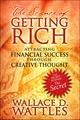
1. I felt this is a book with some strong statements. Strong statements are of course required when change in mindset is required.
2. This book gave me some different perspective in acquiring wealth and in changing mindset. The concept preached is easy to understand but hard to practice. You really need to master the concept to get where you want to be.
3. But some part of this book is quite hard to understand. I need to reread 2-3 times some of the sentences and paragraphs to really get the point.
Subscribe to:
Posts (Atom)